Showing posts with label Shikow TV. Show all posts

Interview with Jeffrey Brown: May 21st - June 7th

JEFFREY BROWN is best known for his bittersweet autobiographical graphic novels, and in just a few short years his impressive body of work has already garnered high praise from the likes of McSweeney's, NPR, and Time… A true artist, who brings together intimacy with imperfection, Brown's most recent graphic novel, The Incredible Change-Bots, continues to reshape the way comics are drawn, told, and made accident.

Pirooz Kalayeh: The new book is due out in July. I'm pretty excited. What made you want to do a satire on Transformers, Go Bots, and all the rest?

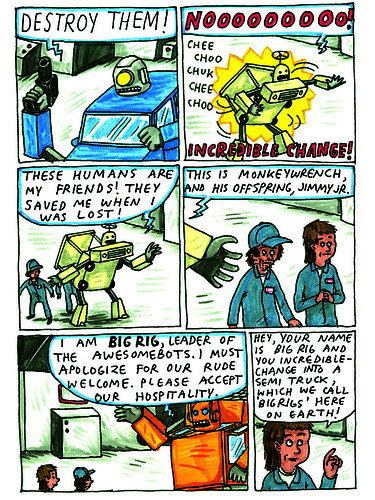
Jeffrey Brown: I grew up as a big fan of the Transfromers cartoon and toys and comics, and I remember my brother and I drawing these Transfromers comics, some of the first comics I drew (mine is unfortunately missing now). They were really funny, so partly I was trying to recapture that. Also, anyone who looks at my comics will probably realize that I'm not a big car guy - I can't identify vehicles, I don't know what different cars are, I draw them almost all the same. So I thought it'd be funny for me to draw all these vehicles because they'd be so inherently flawed.

PK: Mmmm, yes. Flawed things are so wonderful. I often think about Jackson Pollock's statement that he denied the accident in his work, and see how allowing it is so much more nutritious for its freedom and possibility in my own. Would you say your taste is aligned with the flawed image for this reason? Does it have more to do with your overall perspective of humanity?

Jeffrey Brown: I think there's another quote, maybe from Marcel Duchamp, along the lines of the idea that there are no mistakes in art, only accidents, which is how I like to think of it. I want there to be a very real, human presence in my work – to know that these are personal creations. I think there's an intimacy that comes with that. I also like the work to reflect the fact that as people we're not perfect, so the form of the work itself is another comment or parallel to that effect. There's also the idea that aesthetically, when something is flawed it can be more interesting. Imperfections can be differences, escapes from the expected or the commonplace.

PK: I hear you. How do you decide how accidents will be edited within the comic book form? Do you even edit given your predilection for accident as art?

Jeffrey Brown: You can see in Clumsy I barely edited - actually I didn't edit, or if I did I edited right on the page. That was also in keeping with the theme of the book - being clumsy in a relationship, knowing you're screwing up but not being able to help yourself, trying hard but inevitably there are mistakes. I'm more careful now, and I either make fewer accidents or I can cover them up better. I tend to only go back and fix things that really bother me, or that I feel would really detract from the focus of the comic. It also varies from project to project - the non-autobiographical work tends to have a different motivation behind it, so it tends to be edited a little more.

PK: How is the motivation different for the non-autobiographical work?

Jeffrey Brown: With the autobiographical work, I have specific things I'm trying to say, specific ideas I'm trying to express, mostly about life and human experience and what it all means, and so everything in the comics is coming together toward that goal of expression. With the other comics, I'm letting my mind wander quite a bit, and it's more about the jokes, ideas that strike me as funny, whatever thoughts happen to come to mind. So that work is less focused on any deeper meaning, and maybe more entertainment oriented.

PK: Do you find that the process of creating your autobiographical comics were more of a push towards cathartic healing in some sense, and that the non-autobiographical pieces are now an exercise of your craft and experience coming out of this? If so, what would say has been the major benefit in your personal and artistic growth with the entertainment oriented comics?

Jeffrey Brown: The autobiographical comics have never been purposefully cathartic, were never specifically intended to have any kind of psychological benefit to myself, other than coming to some understanding of the world. When I first started drawing autobiography I was pretty happy and in love, actually. The entertainment oriented comics are certainly a place where I tend to experiment and play with form more, but there's still things I'm thinking about there...in the best parts there's some deeper thinking going on, usually about less personal issues.

PK: Like how to kill off most of the characters in Change-Bots? Word is that most of the Change-Bots go to Awesomebot and Fantasticon heaven. Did you plan out the story line to proceed in this fashion, or was it something that was part of your continued accident-approach method? Do you even write plots before a comic begins?

Jeffrey Brown: For this book I had the general plot and basic elements scripted out before hand, but a lot of the details just happened as I went along. Sometimes killing off a robot was just to avoid having to draw them anymore, but maybe it got to the point where there was this kind of liberated feeling, that I could do whatever I wanted to these characters. Obviously, in the autobiography, there's a lot less control over that sort of thing. So the Change-Bots definitely has a bit of that accident approach, but more in terms of story, in that sometimes I'd make something happen and then figure out how to resolve it later on.


______________________________________

Towards the end of our interview, I asked Jeff if he would like to work on a theme song for THE INCREDIBLE CHANGE-BOTS. I am so glad he was game. He sent me the lyrics, and then I wrote this little ditty. It was so tasty that Roberto started dancing in my room when he heard it.

Change-Bots, Incredible Change-Bots
First they're robots, and then you turn around and they're vehicles
Driving all over the place

Change-Bots, Incredible Change-Bots
Chee-choo-che-choo-chook
Shooting each other in the face

Robots from a distant planet
come to Earth and make a mess of it
Change-Bots, Incredible Change-Bots!


"You need to make a music video," he said.

"Okay," I said. "But you have to play the part of the CHANGE-BOT."

"Sure. I can do that," Robert smiled.

Then he started dancing. The rest is celluloid history as they say.

____________________________________


PK
: Is control/inspiration a result of where the drawing decides to go or the text? My guess is that since you have a history in both fine arts and creative writing that both these mediums end up being interchangeable as far as inspirational transitions. Is this the beauty of the comic form, that when you're stuck on what to draw you can rely more on the text to guide you and vice-versa?

Jeffrey Brown: With the autobiographical comics, they're pretty well planned out in advance and basically dictated by the stories. With the other comics I go back and forth a lot more - especially with something like Change-Bots, there's some parts where I just had an idea for something I wanted to draw, so drawing things that look cool changed the look of the story slightly at some points. I don't know that I ever get stuck when I'm at the point where I'm drawing the comics, usually getting stuck happens when I'm working on a script, and it's maybe working things out in my head of how the comic would go visually that leads to figuring out what direction the text needs to go in.
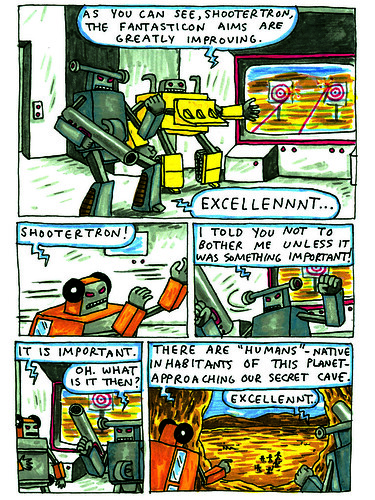

PK: What are some of the best parts of Change-Bots?

Jeffrey Brown: I think the first battle on Earth between the Awesomebots and Fantasticons is pretty funny, and the whole developing friendship between Balls and the humans, Monkeywrench and Jimmy Junior. And the climactic end battle at the reservoir, of course.

PK: You had me at Awesomebots. The book sounds fantastic. I have it pre-ordered now. I can't wait. What about the rumors that you'll be doing a regular series called Sulk. What's this all about and when can we expect the first issue to come out?

Jeffrey Brown: Sulk will collect a lot of random stories - autobiographical, parody, more Bighead, etc - kind of like Feeble Attempts or Miniature Sulk. The plan is to do 3 or 4 issues a year, each one being 32 pages. It'll probably start next year, although there's a possibility the first issue will come out toward the end of this year. My main/big projects the next couple years will be a couple of big autobiographical books, Little Things coming out in 2008 and Funny Misshapen Body in 2009, so Sulk will be a way to balance out with more of the fun stuff, and a place to put a lot of the smaller stories that aren't big enough for their own books.
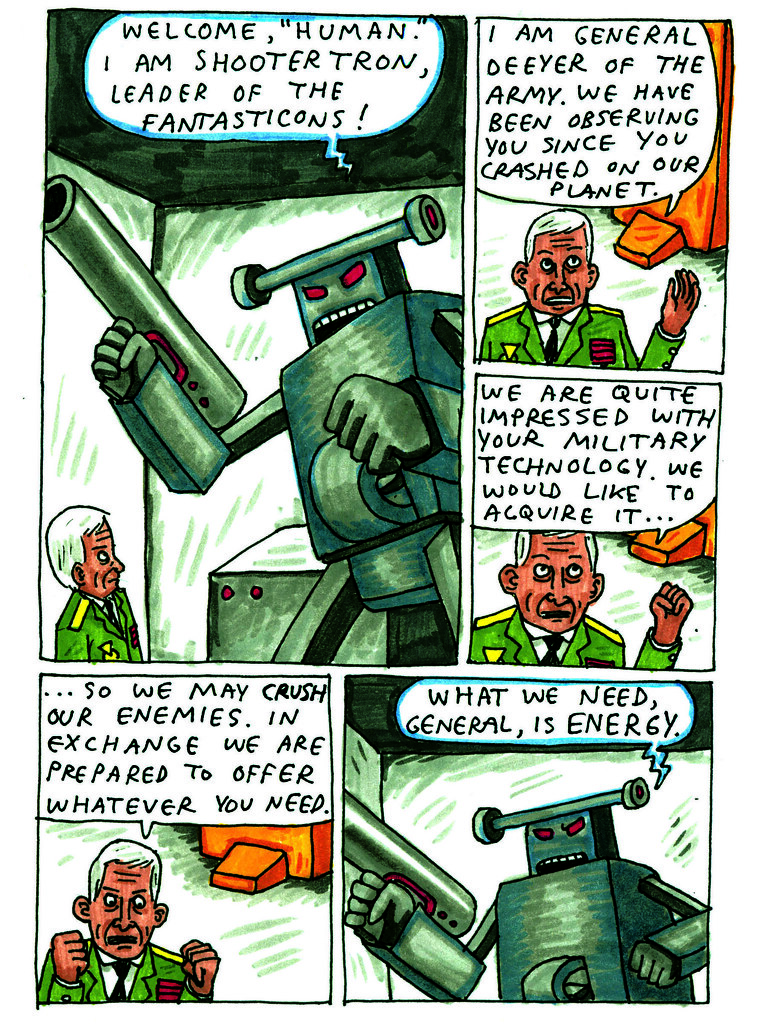

PK: What was the first transformer you owned? Was there one you kept going back to in your memory during Change-Bots?

Jeffrey Brown: Probably Windcharger, the little red car minibot. I never actually owned Optimus Prime or Megatron...nor did I complete my Devastators collection, though I had and loved the bulldozer guy. And despite my love of dinosaurs and literal phobia of insects growing up, for some reason I had a bunch of Insecticons and no Dinobots. Strange.

JEFFREY BROWN is best known for his bittersweet autobiographical graphic novels, and in just a few short years his impressive body of work has already garnered high praise from the likes of McSweeney's, NPR, and Time. Heartfelt and sincere, these memoirs of failed relationships have set a new standard in autobiographical comics and established Jeffrey Brown as one of the leading cartoonists of his generation. A versatile talent, his first graphic novel, Clumsy, appeared seemingly out of nowhere to grab the attention of cartoonists, critics, and comics fans alike. Since then, his works have included fiction, gags, and parodies, as well as further examinations of the human condition. His eleven -- count 'em, eleven! -- Top Shelf publications are featured here, and his comics have also appeared in a host of anthologies from McSweeney's to the Drawn & Quarterly Showcase, as well as local newspapers like the Chicago Reader and NewCity. Brown has been featured on NPR's This American Life and created a short animated music video for the band Death Cab For Cutie. Future work includes a continuing mix of autobiography, gags, satire and parodies, including The Incredible Change-Bots.

Celebrating 40 years of Sgt Pepper's: The Video Ode


The following is a video celebration of the 40th Anniversary of Sgt. Pepper's Lonely Heart's Club Band. It was filmed over 3 days on an $80 polaroid camera in Seoul, South Korea. I interviewed various folks, including the infamous, Roberto, about the effects of the album and the band's overall appeal in Asia after so many years.

I first bought Sgt Pepper's on record, when I was living in a small apartment in Newark, Delaware. I had no furniture, prospects, nothing. All I knew was my record player. I would put Pepper's in rotation with some Dylan, lie on the hardwood floor, and think, "These songs make me happy." Then I would fall asleep to Paul singing "Fixing a hole where the rain gets in." I didn't realize how much that album shaped my life, until after the second record with Cecil's Water came out. I didn't know how much I missed it, until I sang songs with Roberto in my room 10 years later in South Korea.

I heart Roberto. I heart yesterday. I heart Sars and Paprika.

Pop Song Video


You can see me duck Roberto's crane kicks somewhere in the middle. Can you say hilarious?

Bear Video


This is a faux documentary of Roberto and I pretending to be bears for the BEAR VIDEO. In the middle of the documentary, you can see us transform into bears and act in our music video of Tao Lin's poem, A Poem Written by a Bear.

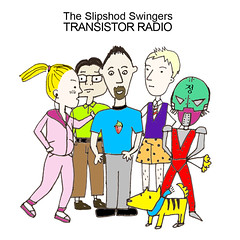
All the music was written and performed by The Slipshod Swingers. You can hear lots of songs by them in the documentary. On one of my favorites, "Tree Song 206," you have the vocal stylings and guitar work of Sonny Mishra. His record with The Temperance will be out on iTunes in a couple weeks.

The rest of the songs were done by Franky Ewing of Downtown Harvest, Timmery, and yours truly.

I hope you enjoy the Bear Video. I hope it makes you laugh and take bears more seriously. We are coming to suburbia. We want turkey sandwices. We like caves and making friends.

_____________

Have you bought Tao Lin's new double-book "Bed" and "Eeeee Eee Eeee." Check it out here.

Interview with Reb Livingston: April 1st - April 20th, 2007

Reb Livingston edits No Tell Motel and has garnered dozens of publications as a poetry guru. An artist who does so much more than give a middle finger to theory and the mainstream, Reb is one of the few editors who is changing how poetry is seen, distributed, and made from behind the scenes and on paper. Over the past couple weeks, I got to pick her brain about publishing, her broad range in taste, and find out some juicy secrets about taxes, writing, and her infamous Motel.

Pirooz Kalayeh: No Tell is a hot little number. I love its gossip made secret. How did you come up with this model for a journal?

Reb Livingston: The new poem a day was a concept beaten into me during my employment at AOL during the mid-90's. People only came back to places where they could depend on new and dynamic content showing up. AOL had statistics up the wazoo proving that. This was important to the company because they wanted to sell advertising. It became important to me regarding No Tell Motel because I wanted regular readers. I liked how Dan Nester did Unpleasant Event Schedule by focusing on one poet at a time, so Molly Arden and I tweaked his idea and made it way cuter.

In terms of the theme (for lack of a better word), one time when I was 12 I bought a tee shirt for my little sister with a No Tell Motel neon sign and a woman saying "Sshhh." I didn't get it at the time, but I must have psychically drawn to the message, because I love the idea of being naughty without being crass.


PK: Do people ever object to the advertising (AOL) know-how you employ on No Tell? And, if so, how do you deal with this position of poetry as non-commodity?

Reb Livingston: I don't consider it so much "advertising" know-how -- even if that is where I first learned about content programming and audience development. I mean, NTM doesn't sell or have advertising anywhere on the site, we don't make a single penny. The difference is that AOL changed it's content strategy to maximize advertising sales, it made a lot more money from advertising than from membership fees so advertisers became their priority. That's why it sucked so bad. NTM's goal is to connect poems and poets with as many readers possible. NTM puts the emphasis on both the poems and the poet, puts the poems top level and easy to access. Every poet gets the same treatment and same chance to be read during her week, whether the reader recognizes her name or not. I wanted to utilize the benefits of the online medium, not try to cram in the strategies of print publishing. People don't read from the screen the same way they read paper. So yes, working at AOL for almost four years was definitely an educational experience that I'm still utilizing a decade later, but I don't think I'm employing the slick, empty and inane aspects of what happened with AOL's content programming during the mid-90's. In that respect I learned a lot about what not to do.

People object to all kinds of things, the cheekiness and pinkiness of the design, limiting the content to poems only and not employing reviews, criticism, or fiction. Some people don't like the variety of styles we publish. I'm not so concerned with what a handful of people object to -- Molly and I do what we like, enjoy ourselves and are proud of the work we publish.

PK: By adhering to your standards of multiplicity and inclusion, do you feel that NTM has the potential to broaden poetry’s scope?

Reb Livingston: Possibly. While we definitely aren't open to *anything* (we're two editors with our own limitation like anyone else) -- the range of styles, subjects and poets are broader than many poetry magazines, but because it's not packaged all together at once, readers don't get a disjointed mishmash. In a time when some are intent on categorizing and pigeonholing poetry and poets, NTM isn't avant-garde, experimental, traditional, formal, mainstream, or alternative - yet we publish poems and poets who are routinely placed in one or more of those categories. There's pressure to take a stand, pick some kind of arbitrary side, make alliances, if you don't, nobody knows what to do with you. "What are you?!?" they insist. We want to know all about you before we ever meet and we want to figure you out fast and without much effort. Write one pig-fucking poem and you're forever associated with the New Pig Fuckers. Then your dad googles you and wants to know why you're so intent on ruining the family name with your rampant pig fucking. It's viscous.

I think NTM goes against that grain. There isn't a typical NTM poet or poem; at least I don't think there is. Some people think we only want sex poems. I have nothing against sex poems and have published a number of them, but that's a small slice of what the magazine offers and sometimes when I'm cranky and reading submissions, I get easily annoyed. We do contribute to that misconception with the design and of course the Bedside Guide anthology. We expect people get our many aspects, but not everybody will -- and that's unfortunate, but life.

So yeah, the way NTM is set up, if a reader visits one week and doesn't like what's there, she knows next week is different poet with totally different poems and is likely to come back. Also, because of the focus on individual poems, a reader is more likely to read something they might skip over or flip past in another format. In that way, I believe the scope is broadened.
_______________________________________

"My Uncommon Concubine"

Words and Vocal by Reb Livingston
Music and Film by Mr. Pirooz


As we had some spare time in our busy schedules, we decided to cooperate on some music and an interview. The music turned into a music video. Reb managed to send me an audio file virtually, and then I got the music done after about 18 hours. It was a bit hard, but so worth it. The film was fun too.

_______________________________________

PK: Does inclusion and diversity factor into the stylistic range of your writing?

Reb Livingston: It does, but it's not especially intentional. Because I'm a touch magpie in my preferences, those influences bleed into my work -- although I'm not writing dramatically different work during any single stretch. My writing process is very intuitive, gives a middle finger to theory and fashion. I tend to write in phases, get on a kick that might last a couple weeks or a few years and mostly write work in a similar vein until it feels exhausted and it's time to move on to something different. It's not something I'm able to consciously control, I've tried breaking my flow with something very different, but if I'm not ready it doesn't happen, no matter how hard I force it. These days I fight a lot less with my process and work harder to go with it -- and find I'm much more productive that way. Mother knows best, as they say.

PK: Have you always felt the itch to raise your middle finger to theory and fashion? Did you ever feel differently?

Reb Livingston: No, especially not as a student. Theory was shoved down my throat as an undergrad and I tried really hard to see the point of it in poetry. Took me years to recover from the damage it caused my fragile little psyche. Fashion was more alluring, but in the end false and insincere. I remember during my mid-20's reading the "hot" new collections by younger authors, the ones being reviewed in big circulation magazine. I thought well, better start writing like that. I was easily influenced because back then my work didn't have any strong inclinations and not only did I not have a clue what I was doing, I hadn't a clue what I wanted to do. These days I have my own ideas and am secure enough that I'm only moderately perturbed when I read or hear a comment starting out with "like all good poets/poems/editors ________"

PK: What do you want to do now?

Reb Livingston: Right now I want to finish my taxes. Actually I don't really want to finish my taxes, I want them to be magically finished and I don't want to owe the government any money. I'd also like to take a nap, but that doesn't appear to be in the cards today.

I'd like to be able to garner up the momentum to be able to finish the projects I started. I'm cornered by loose ends. I tend to have an over-optimistic view of what I can accomplish within a tight timeframe. I'm learning, slowly.

I hope I can keep up the pace I've been maintaining on my current writing project.

PK: Jack Spicer often spoke about transmissions from Mars. He felt that the voices in his head - editors, friends, and audience - would fall away to Mars' static-free blips. Do you participate in a similar stripping of thought when you work? Do you even think at all?

Reb Livingston: I have trouble meditating, I don't get transmissions from other planets -- or if I do, I can't hear them over the squirrels spinning in their wheels. They're very loud and they rarely take breaks. My mind is very busy, fractured, all over the place, a real mess. It's not the voices of friends, family and audience in my head -- it's my own voices, and I don't know all of them, and I'm often meeting new ones, sometimes scary ones, sometimes I spend years trying to avoid them. Sometimes they slip into my poems and freak me out. Sometimes I find out they're not so scary after all. Sometimes I discover they're a lot worse than I imagined and they get me into trouble.

So I guess what I'm saying is that somebody is thinking and that somebody in the end is me, but it's often not a part of myself I'm on regular speaking terms with, or if I am, I'm reluctant to admit it.

PK: How much of your poetry is part of getting on speaking terms with the voices you may be reluctant to converse with? Is this the secret to NTM as well?

Reb Livingston: Hah, well, recently I was psycho-analyzed by two dear poet friends who suggested that I started No Tell Motel during a period in my life when I wanted to acknowledge the existence of secrets in some way, not spill them mind you, let them out of attic, store them in a bedside drawer. I was kind of floored by their reading, but maybe they weren't too far off. For years I made the point not to write about anything that made me squeamish. What resulted was a slew of anxiety-ridden, ugly squeamarrific poems. These days I'm more open to those voices, let them jabber -- I can always edit them out afterward, although I'm finding once they make it on the page they often stay there.

PK: At the day's end, would you say you have reconciled with the jabber? Is it simply walks on the beach with a walrus after that? Or, do you hire the walrus to do your taxes?

Reb Livingston: There's no reconcile with the jabber! Never. If I'm lucky it'll be a perpetual skirmish. But the jabber seems sincere, however off kilter, fucked up and menacing. I left the walrus behind and I hope the waves washed away my footprints. Oyster suck, soul suck, charm aside, the walrus is the bad energy masquerading as friend not to be trusted to do anyone's taxes.

Reb Livingston is the author of Your Ten Favorite Words (Coconut Books, Fall 2007), Pterodactyls Soar Again (Whole Coconut Chapbook Series, 2006) and co-author of Wanton Textiles (No Tell Books 2006). Her work has appeared in Best American Poetry 2006 (Scribner). She's also the editor of No Tell Motel and publisher of No Tell Books. With Carly Sachs she co-curates the Burlesque Poetry Hour.

No Shampoo Lyrics and Take with Soju

People have been asking so here are the lyrics to No Shampoo and a special version with Soju in hand:

We didn't shampoo.
We say hello.
Now we feel like
we're going to die.

Her name is Hyung eeee.
She studies SAT's.
Now she feels like
she is going to die.

We drink Soju.
We drink till 2.
Now we feel like
we are going to die.

Come join us tonight.
Come join in the light
and we will not die.
We are from Korea smile!


Inspiration? Good question. One of the office workers lifted my hat, and said, "No shampoo!" It was as simple as that. Now we even have tee shirts. Who would have thought?

No Shampoo

New Korean band, No Shampoo, practice their latest hit entitled, No Shampoo. Known for their late nights of Soju drinking in Suyu, this ragtag group of musicians rarely shampoo, go to bed after two, or use English past a third grade reading level.

"It's just how we roll," says Roboto, guitarist for the group. "There's no reason to complicate things. We're just about the light, man, the light. If that means we drink soju or don't shampoo to get there, then that's what we'll do."

The group is set to perform at Suyu's annual Pop Song Contest. For information on further shows, or to send an email to the group, visit their myspace page at NO SHAMPOO.

Class 217

This was a funny reel I made with my students. It makes me laugh a lot.

American Painting

Well, today was eventful. I finally got some paints. Two tubes. One light green and the other a zinc white. In the middle of work, I got the idea to document what I was doing. Then I just started having too much fun making this short.

Shikow TV: "Wax On, Wax Off"


We had a brief minute of solitude at the office. Luckily, Sheldon was around to teach me Karate. I felt just like Ralph Macchio. Maybe, you will too.

Shikow TV: "The Great Fitzby"


Me holding the camera again. Not so bad. It was hard though. Again, the Great Fitz makes me laugh a bit too hard. This time I just let it out. That's the only way.

Now Fitz is in Philly. The end of an era. Hopefully we will be able to make more films in March when his tour comes back to Los Angeles.

This film is a little repoire that he and I would jump into when things got a bit slow at the office.

It goes out to L.O.U., Posatko, IndianaGirl, and all my wonderful friends at the WG. I will see you all soon. I love you, P.

Click here or on pic to see The Great Fitzby in action.

Shikow TV: "Fitz, the Logger"


"Fitz, the Logger"

Fitz: Larry Thomas Moore

I did the camera work here. Sorry. I couldn't stop laughing. It shakes the whole way through.

Click here or on pic to see Fitz do an impersonation of yours truly.

Shikow TV: "Sheepman PSA"


Episode One

Director: Vince Braun
Ideaman: P. M. Kalayeh
Sheepman: Jeffrey Peterson
Fitz: Larry Thomas Moore
Audio: Panauh Kalayeh


To watch th
e film click image or here.

Thank you to Jeff Peterson for being in this piece. It was a pleasure to watch you at The Comedy Store. You humble us with Sheepman's presence here at Shikow TV.

_______________________________________

Last night's dream:

Byron Katie rubs underneath my chin. She does the same to my parents. This makes us naked.

I am at some type of guru session. There are people crowded around Byron Katie.

I am invited to move up to her. I get in full lotus. She lifts a sheet of rock she is sitting on, and puts my legs underneath to hold me in place.

I hang underneath her. Bat style.

There is nothing underneath me.

We are suspended in the air.

__________________________________________

Last Night's Excursion:

I went to the Comedy Store on Sunset. I got to see Jeff and Shannon perform. They did wonderful jobs.

I was surprised how hard the comics were on themselves post-performance.

"That bit needs to be adjusted," one says.

"I was average," another says.

"Comedy is science," the group agrees.

I don't believe any of this. I know better. I have seen the same thing from musicians. I have listened to the same thing from writers. It is such a torturous way to be an artist. The idea that anything is science puts me right back into physics with Mr. Lagsney. It shows me Mr. Liu coaching tennis without being able to hit a ball. It's my dad preaching self-help books by Deepak Chopra while he terrorizes his family. It is Ann telling me my language is too romantic. It is the ESL instructor who made me practice saying "apple" when I was already reading Ghandi's "All Men Are Brothers."

When I hear comedians (can you believe it's comedians?) rip themselves apart, I see every bad teacher on this planet. I see every moment someone was put down or told they weren't good enough. I hear a father shouting about winning and losing. I hear society calling down with rules and procedures. I see the worst of religion. I see corporations squeeze America through a funnel.

I know that "Comedy" or anything as "science" is not the way to make art. I know it is not the way to live life.

Dear Dad,

Tough love does not help or nurture.

Dear Mr. President,

A big stick will not make me bend.

Dear Ghandi,

I know we can offer ourselves better. I know we can hold a better space.

Dear Mrs. Ellis,

I love you. Thank you for saving me. Thank you for believing in me. I won't ever forget.

Dear Comics,

Comedy is not science.

Dear Teddy,

I walk like a penguin and carry a great laugh.

The Desert Rose

P.S. "Dad always thought laughter was the best medicine, that is why several of us died of tuberculosis." -- Jack Handy

Shikow TV: "Buddha, the Explorer"


Episode Two

Director: Vince Braun
Writer: P. M. Kalayeh
Buddha: Joe Robinson
Fitz: Larry Thomas Moore


To watch th
e film click image or here.


Shikow TV: "Buddha, the Explorer"


Episode One

Director: Vince Braun
Writer: P. M. Kalayeh
Buddha: Joe Robinson
Fitz: Larry Thomas Moore


To watch th
e film click image or here.